Double Opt-In vs Single Opt-In: Which One Fits Your Email List?
Double opt-in vs single opt-in compared on consent proof, bad addresses, complaints and list growth, with a break-even formula to test both on your own numbers.
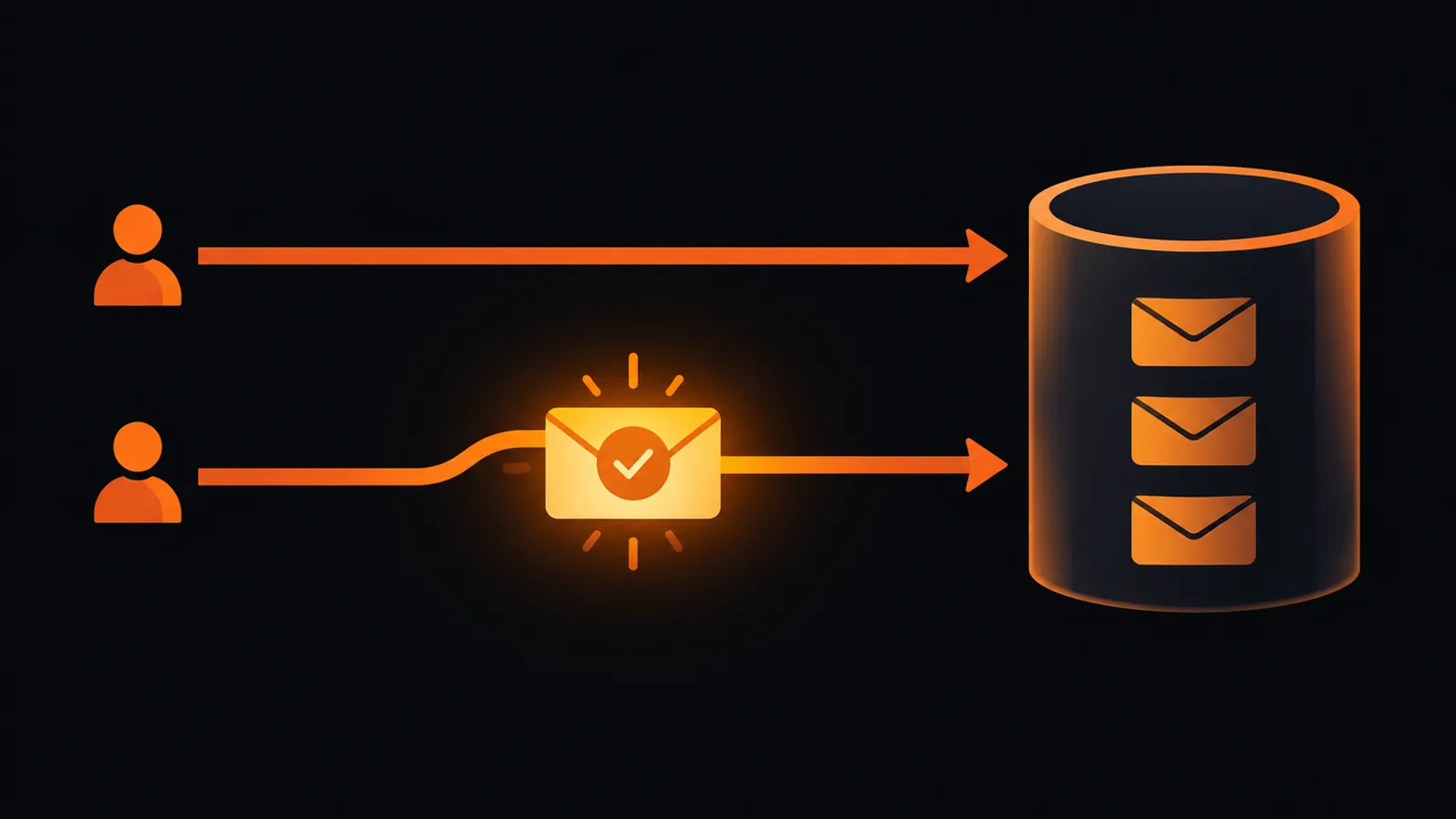
Single opt-in adds a person to your list the moment they submit the form. Double opt-in adds them only after they click a link in a confirmation email. Neither is legally required everywhere, but both need a clear action from the subscriber and a record you can show. Choose double opt-in when bad addresses, complaints or proof of consent hurt you most; choose single opt-in with validation when growth speed matters more. Section 4 gives a break-even formula to decide on your own numbers.
The difference is one extra step. With single opt-in, the form submission is the whole signup. With double opt-in (also called confirmed opt-in), the form submission only creates a pending contact, and the address joins the list after the owner of that inbox clicks a link in a message you send. The choice trades list size against list quality, and the right answer depends on where your losses come from. This guide compares both on the four things that matter, then gives you a formula to test them with your own data.
How each method works, step by step
Single opt-in: the visitor enters an address and ticks or clicks to subscribe, and the contact is active at once. Double opt-in adds a second stage: the contact is stored as unconfirmed, a confirmation email goes out with a unique link, and the contact becomes active only after the click. Unconfirmed contacts should receive nothing else, and the link should expire (many teams use 24 to 72 hours, a choice you make, not a rule).
Two details decide whether double opt-in works at all. The confirmation email must arrive quickly and look like the message the person expects, and your form must say plainly that a confirmation email is coming. Without both, genuine subscribers drop out at step two.
What the rules actually require
The most common claim about this topic is that double opt-in is mandatory in some places. The official sources read for this article do not say that. What they do say is more specific:
- The UK Information Commissioner's Office states that you must not send electronic mail marketing to individuals unless they have specifically consented to email from you, and gives ticking an opt-in box as an example. Its page on email marketing does not mention double opt-in or any confirmation step.
- The ICO consent guidance quotes the GDPR rule that the controller must be able to demonstrate that the person consented. It requires a clear affirmative action, and says you cannot rely on silence, inactivity, pre-ticked boxes or opt-out boxes. It lists responding to an email requesting consent as one valid active opt-in method.
- The same guidance repeats that withdrawing consent must be as easy as giving it, so every message needs a working unsubscribe.
- Yahoo's sender guidance tells senders to email new subscribers asking them to click to confirm, recommends double or confirmed opt-in to reduce invalid recipients, and says not to subscribe people with a pre-checked box.
So the legal floor is: a real, recorded, affirmative choice by the right person. Single opt-in can meet that when the form is clear and you keep a record of when and how each address signed up. What single opt-in cannot do on its own is prove that the person who typed the address owns the inbox; a confirmation click does. That gap is why double opt-in is the stronger evidence if consent is ever disputed. This is general information, not legal advice; the rules of your own country and of the laws that apply to your audience decide.
Double opt-in vs single opt-in compared
| Question | Single opt-in | Double opt-in |
|---|---|---|
| Signup steps | One | Two (submit, then confirm) |
| Typos and fake addresses | Enter the list unless you validate at the form | Never confirm, so never become active |
| Someone signs up another person | Possible; the real owner gets mail they did not ask for | Only one message (the confirmation) reaches them |
| Proof of consent | Timestamp, IP and form text show the submission, not the inbox owner | Adds proof that the inbox owner acted |
| List size after the same traffic | Larger | Smaller by the share who never confirm |
| Spam complaints and invalid recipients | Higher risk | Lower risk |
| Cost per active subscriber | Depends on your validation | Includes the confirmation send |
Bounces matter because sending to addresses that do not exist is a common cause of damage to a sender's reputation; see what a 550 5.1.1 bounce means. Complaints matter because Yahoo asks bulk senders to keep the spam rate below 0.3%, a figure it calculates from mail delivered to the inbox.
A break-even formula you can test on your own numbers
Search results quote percentages for how many people skip the confirmation step. Those numbers come from vendor blogs and vary widely, so do not plan around them. Measure your own, then compare the two methods by the number that pays the bills: active subscribers per 1,000 form submissions.
- Single opt-in:
1000 × (1 − b) × as, where b is the share of submissions that are bad addresses and as is the share of valid subscribers who stay active. - Double opt-in:
1000 × c × ad, where c is the share who confirm and ad is the share of confirmed subscribers who stay active. - Double opt-in wins when
c > ((1 − b) × as) / ad.
Worked example. These inputs are assumptions for illustration, not research findings: 5% of submissions are bad addresses (b = 0.05), 30% of single opt-in subscribers stay active (as = 0.30), and 45% of confirmed subscribers stay active (ad = 0.45).
| Scenario | Calculation | Active subscribers per 1,000 submissions |
|---|---|---|
| Single opt-in | 1000 × 0.95 × 0.30 | 285 |
| Double opt-in, 50% confirm | 1000 × 0.50 × 0.45 | 225 |
| Double opt-in, 70% confirm | 1000 × 0.70 × 0.45 | 315 |
| Double opt-in, 80% confirm | 1000 × 0.80 × 0.45 | 360 |
The break-even confirmation rate is 0.95 × 0.30 ÷ 0.45 = 0.633. Below 63.3% confirmations, single opt-in produces more active subscribers in this example; above it, double opt-in does. Replace the three inputs with your own and the answer changes, which is the point. Three notes on reading the result. First, ad must come from the same type of subscriber, not from a different channel. Second, the formula ignores complaint and reputation costs, which favour double opt-in. Third, it ignores the value of the larger single opt-in list that never engages; if you pay per contact, that list also costs money.
Email ValidatorSyntax, MX, disposable and typo checks, single or bulkOpen the tool →Single opt-in without the usual damage
Single opt-in is not careless by definition. Most of its risk comes from addresses that should never have entered the list. You can cut that risk without a second step:
- Validate at the form. Check syntax, catch common domain typos such as
gmial.com, and optionally confirm that the domain has mail servers. The email validation guide explains what each check can and cannot prove. - Send a welcome email immediately. The first message works as a soft confirmation: bounces show up at once and you can suppress those addresses before the next send.
- Keep consent records. Store the timestamp, the exact form wording, the page address and the source for each contact.
- Never pre-check the box. The ICO and Yahoo both name pre-ticked boxes as something to avoid.
- Prune quickly. Remove hard bounces after one send and review non-openers and non-clickers on a schedule; the list hygiene guide has the routine.
Which one to choose: a decision guide
| Your situation | Lean towards |
|---|---|
| Your audience is in a region where regulators scrutinise consent, or you sell to businesses that will ask for proof | Double opt-in |
| You have seen bounce or complaint spikes after campaigns or giveaways | Double opt-in |
| Signups come from forms that bots or typos can reach (public pop-ups, contests) | Double opt-in |
| Signup happens inside a checkout or an account you already verified by email | Single opt-in (the address is already confirmed) |
| Low-friction signups where each lost subscriber is costly and you validate at the form | Single opt-in with validation |
| You cannot decide | Run both on split traffic for a month and apply the formula above |
Many teams use a hybrid: single opt-in for people who signed in or bought, and double opt-in for anonymous forms. That keeps friction where trust already exists and adds proof where it does not.
Common mistakes with confirmed opt-in
- Forgetting to say a confirmation email is coming. The thank-you page should say "check your inbox" and name the sender.
- Sending the confirmation from a different domain than the one in the welcome emails. Mismatched senders look like phishing and land in spam.
- Adding marketing to the confirmation email. Keep it to one purpose and one button.
- Letting unconfirmed contacts receive campaigns. That removes the benefit and the consent evidence.
- Not following up once. One reminder after a day recovers some people who missed the first message; more than one turns a request into pressure.
- Treating a confirmation click as permanent permission for anything. It covers what the form promised. If you collected consent for a newsletter, it does not cover unrelated products.
- Hiding the unsubscribe link. Withdrawing consent must be as easy as giving it; the one-click unsubscribe header adds a mailbox-level button on top of the link.
Mailbox-provider rules change over time, so check the current bulk sender requirements before you plan volumes.
Frequently asked questions
Is double opt-in required by law?
The UK ICO pages used for this article require specific, recorded, affirmative consent for email marketing to individuals and do not mention double opt-in or any confirmation step. Whether your situation needs more depends on the laws that apply to your audience, so ask a qualified adviser. Double opt-in is the stronger evidence either way, because it shows the inbox owner acted.
Does double opt-in improve deliverability?
It reduces the main causes of reputation damage: invalid addresses and people who never asked for the mail. Yahoo recommends double or confirmed opt-in to reduce invalid recipients. It does not guarantee inbox placement, which also depends on authentication, content and engagement.
What is the difference between confirmed opt-in and double opt-in?
Nothing in practice. Both names describe the same two-step process: the person submits the form, then clicks a link in a confirmation email.
How many people skip the confirmation email?
It varies by form, audience and email design, and published percentages come from vendor blogs rather than primary research. Measure your own confirmation rate for two or three weeks and put it into the break-even formula in this guide.
Can I convert a single opt-in list to double opt-in?
You can ask existing contacts to confirm in a re-permission email, but anyone who does not respond should be treated as unconfirmed and moved out of regular campaigns. Doing this on an old, inactive list usually loses most of it, which is often an accurate picture of how engaged the list was.
Should the confirmation link expire?
A short expiry such as 24 to 72 hours limits stale or forwarded links. This is a design choice rather than a standard; the person can always sign up again.
References & further reading
Related articles
 List Hygiene & Validation
How to Validate Email Addresses in Bulk: What Syntax, MX and SMTP Checks Really Prove
How to validate email addresses in bulk: the layers from syntax and MX records to SMTP probing, what each proves and how to avoid hurting reputation.
7 min read List Hygiene & Validation
How to Remove Duplicate Emails From a CSV Without Losing Real Contacts
Remove duplicate emails from a CSV by matching on a normalized key: trim, lowercase, and apply Gmail dot and plus rules only where they hold. Worked example.
9 min read List Hygiene & Validation
SMTP 550 5.1.1 Bounce Code: What It Means and How to Fix It
550 5.1.1 means the recipient mailbox does not exist. Learn how to read the code, tell it from 5.1.2, 5.2.2 and 5.7.1, and clean your list correctly.
5 min read